
Search Smith County Property Records
Smith County Property Records are centered in Carthage, the county seat, where the local offices handle the parcel, deed, tax, and appeal trail tied to real property. If you are trying to confirm who owns a parcel, trace a recorded transfer, compare an assessment to the deed file, or figure out which county office should answer a records question, the safest first step is to stay local and use the Smith County contacts that actually hold the file. This guide keeps the search anchored in Carthage and points you to the county and Tennessee resources that matter most for Property Records research.
Smith County Property Records Facts
Smith County Property Records Search
The most useful place to orient a Smith County Property Records search is the CTAS county profile at ctas.tennessee.edu/county/smith. It gives a county-level snapshot that helps confirm the local setting before you start moving between offices. The Smith County officials directory for 2022 to 2026 is the other essential support source, because it lists the current local contacts for the register, trustee, county clerk, circuit court clerk, and clerk and master. That matters in practice because a property search usually begins with one clue, then turns into a choice about which office actually holds the record.
The directory lists Jerri Vaden-Malone as Register at 615-735-1760 and jvaden@titlesearcher.com, Julie Wright as Trustee at 615-735-8242, Clifa L. Norris as County Clerk at 615-735-9833, Tommy Turner as Circuit Court Clerk at 615-735-0500, and Jessie Goad as Clerk & Master at 615-735-2092. Those names are more than a contact list. They help you decide whether the question belongs with a deed, a payment history, a court-related file, or another county record that touches real property but is not itself a deed.
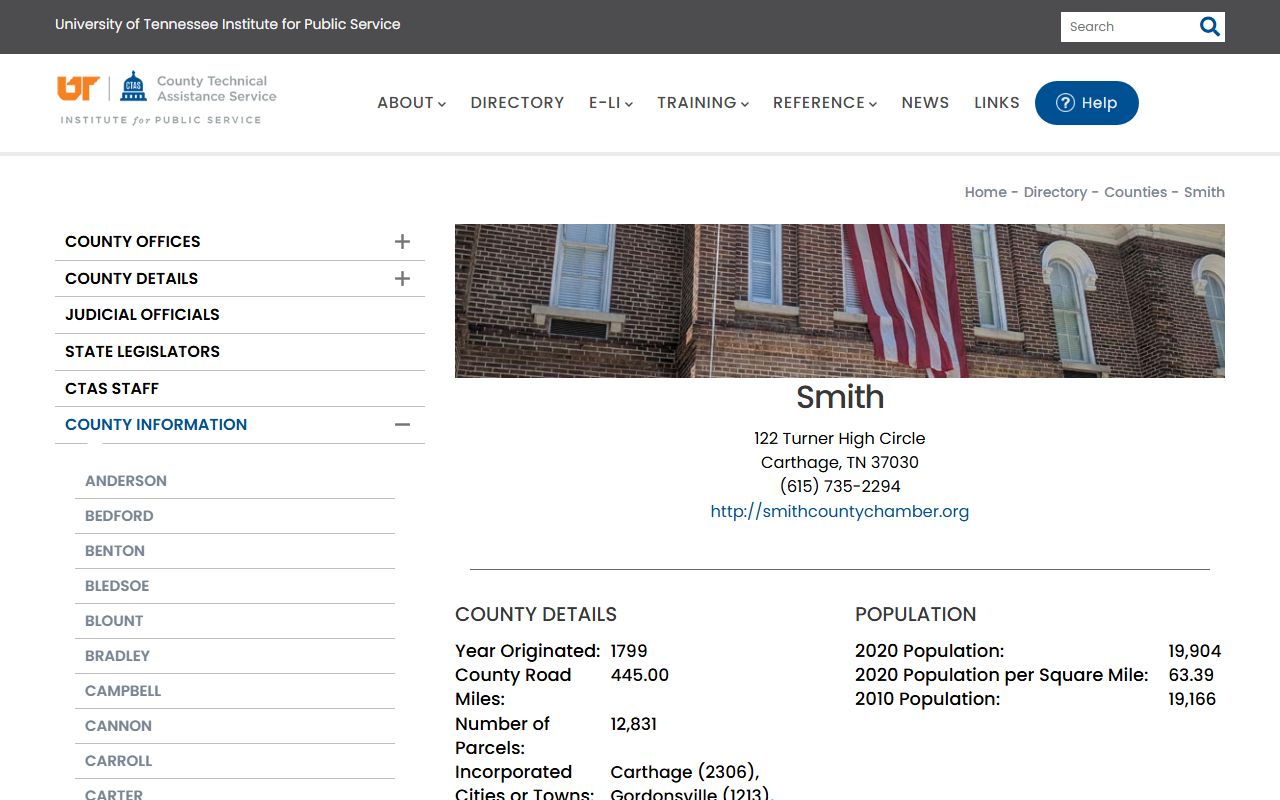
The image above stays linked to the CTAS county profile because Smith County Property Records are easier to use when the county seat, office contacts, and property record trail are all kept in the same local frame. If you only have a name, start by thinking deed. If you only have an address, start by thinking parcel and assessment. If you are not sure yet, ask the county office that actually keeps the file instead of forcing every search into one broad web query.
Smith County Property Records And Assessment
Assessment records are the backbone of most Smith County Property Records searches because they tell you how the county is carrying the parcel, who the current taxpayer appears to be, and what map or parcel reference is attached to the property. The county assessor is the first local office to contact when an address does not match your notes, when a parcel number looks wrong, or when you need to move from a street location into the county's valuation file. In practice, the assessor helps you get from a loose property clue to a file that can be matched against the recorded documents.
Tennessee's assessment viewer is the best statewide map support to use when you need parcel context. It can help confirm the location and map pattern before you call the county office, which is especially useful when the property sits on a boundary, has changed hands more than once, or has a mailing address that does not obviously match the land record. The project manifest marks TPAD as failed, so this page does not treat TPAD as dependable local access for Smith County Property Records. The state viewer is the safer backup.
For the state-side framework behind valuation work, use the Comptroller's Division of Property Assessments page and the assessment schedule. Those pages explain how Tennessee organizes the assessment process, but they do not replace the local Smith County file. If the county record and the map viewer do not line up, the next move is to contact the local office and ask which file controls the current parcel view.
Smith County Property Records And Deeds
The recorded-document side of Smith County Property Records belongs with the Register of Deeds. Jerri Vaden-Malone is the register listed in the 2022 to 2026 county and district officials directory, and that office is the place to ask about deeds, recorded transfers, plats, and other land instruments that become part of the county record book. When a property search needs the paper trail of ownership, the deed index is the file that matters first, because it tells you what was actually recorded and how the county indexed it.
That recorded trail is useful, but it has limits. The register can point you to the filed document, copy it, and help you search by names or by recording details, but the office is not a private title company and it is not the same thing as a full ownership opinion. That distinction matters in Smith County Property Records work because a deed can be correct while a separate question about liens, liens releases, or title history still requires more review. The local record is the starting point, not the last word.
If the deed packet includes transfer paperwork, Tennessee's real property transfer tax guidance helps explain the state-side tax component that may accompany a filing. That is useful when you are sorting a sale, a refinance, or another transaction that produced a recorded deed. The county document remains the core source, but the state transfer tax page makes the packet easier to understand once the recording side is in view.
Carthage Property Records Access
Carthage is the practical center of Smith County Property Records access because the county seat brings the local offices into one place. That makes the city useful not just as a map reference, but as the place where the office names on the directory become real, reachable records contacts. If you are planning an in-person search or a phone call, start with the office that matches your clue. A deed question belongs with the register, a bill or payment question often belongs with the trustee, and a general county filing issue may fall to the county clerk or another office depending on the document type.
The county clerk, circuit court clerk, and clerk & master matter because not every property issue stays inside the deed book. Some questions connect to court filings, estate materials, partition actions, or other records that affect a parcel without being a straightforward deed lookup. Tommy Turner at 615-735-0500 and Jessie Goad at 615-735-2092 are listed in the official directory for those court-side offices, and that gives you a cleaner path when a Smith County Property Records search expands beyond a simple deed request.
If the record you need is held by Tennessee rather than Smith County, the Comptroller's public records requests page is the proper state route. Most property searches still begin locally, but the state request process matters when a file is not maintained by the county office you first contacted. That keeps the search tied to the office that actually controls the document instead of sending the request into the wrong queue.
Smith County Property Records Appeals
When a Smith County Property Records question turns into a value dispute, Tennessee's State Board of Equalization and its value appeals guide are the state references to use. Those pages explain how the appeal path works after local review and what kind of documentation belongs in the file. That matters because many owners start with what looks like a deed or parcel problem and later discover that the real issue is an assessment value or classification question.
A strong appeal packet usually stays close to the record itself. Keep the notice, parcel reference, photos, measurements, and any recent sale data together so the county and state reviewers can see exactly what changed and when. The assessment schedule helps you understand the timing behind the review cycle, while the county office provides the local file that should match the notice. If those pieces do not line up, the issue is usually in the record trail, not in the form you used to ask the question.
Property tax relief and other tax programs can also matter once a property search moves into the billing side. Tennessee's property tax relief page and property tax programs page are the right state references when the file involves qualifying ownership categories or special tax treatment. Those resources do not change the deed trail, but they do help you understand the tax side of Smith County Property Records once the parcel is identified.
More County Pages
If you need another county after reviewing Smith County Property Records, use the live county pages below. Each page follows the same structure but stays tied to its own local offices and record trail.