
Search Marshall County Property Records
Marshall County Property Records are easiest to use when you start in Lewisburg and follow the courthouse office that actually maintains the file you need. The assessor keeps the parcel and tax-map context, the register of deeds records the land transfer trail, and the trustee handles the tax-account side. If you are trying to confirm ownership, compare a deed with a parcel card, or find the right office to request a local record, this page gathers the main Marshall County Property Records paths in one place so the search begins with the county offices instead of a generic directory.
Marshall County Property Records Facts
Marshall County Property Records Search
The county's official website and the CTAS county profile are the best first stops for Marshall County Property Records because they keep the courthouse offices, the county seat, and the main contacts together. CTAS identifies Marshall County as a Traditional county with Lewisburg as the seat, and the county website places the assessor, register of deeds, trustee, and public-records policy in one local structure. That makes it easier to decide whether your search starts with a parcel number, a name, an address, or a recorded instrument.
The assessor's office is especially useful at the start of a Marshall County Property Records search because it maintains the ownership of property records and updates tax maps showing where properties are located. The page for the Assessor of Property also links to real estate assessment data, GIS Map & Parcel Search, the assessment schedule, and other statewide assessment references. Those tools do not replace the county file, but they help you confirm that the parcel you are looking at is the right one before you move on to the deed or tax side.
For a quick county snapshot, the CTAS profile at ctas.tennessee.edu/county/marshall is a useful companion to the county offices, and the county's current website is marshallcountytn.gov. Together, those sources show the current local office structure and the courthouse-centered path for property research in Lewisburg.
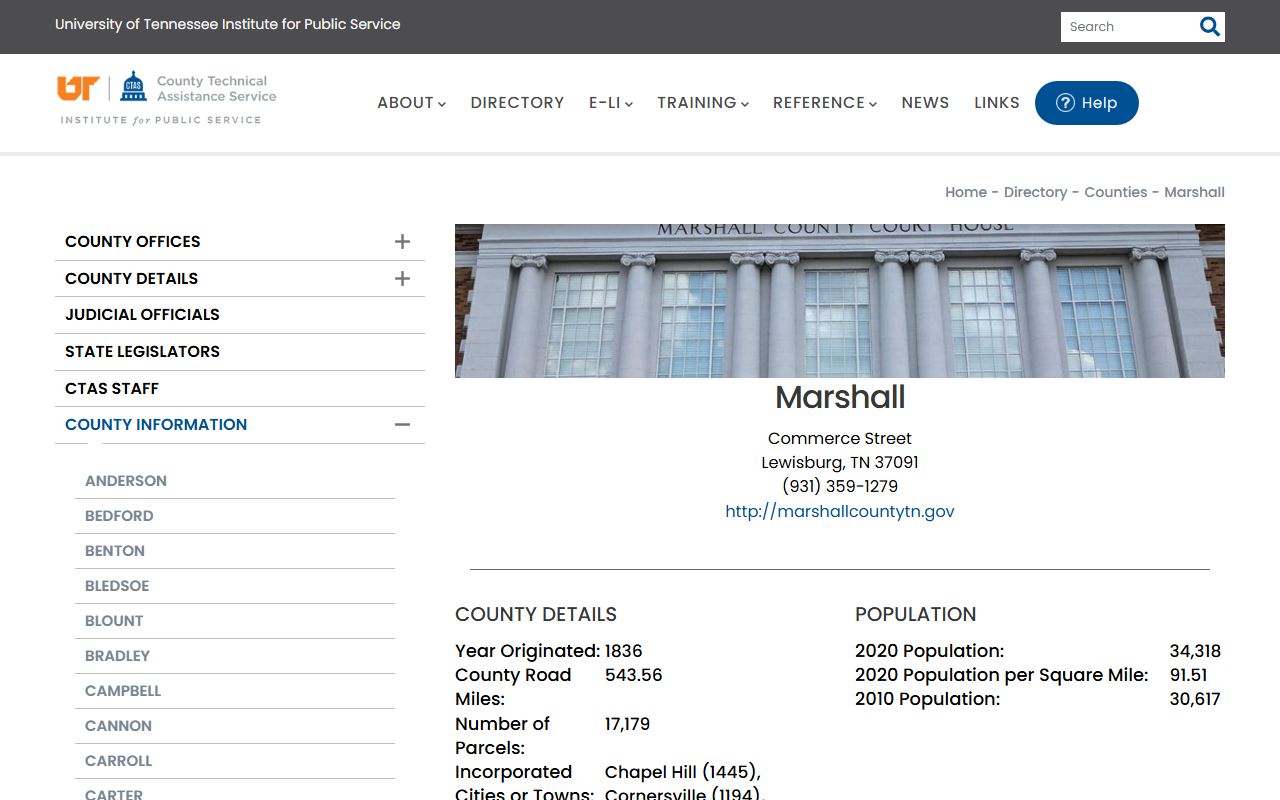
The CTAS image is useful here because it reinforces the county seat, the parcel count, and the local office structure that shape Marshall County Property Records work.
Marshall County Assessment Records
Jennifer Neill serves as Assessor of Property, with the office listed at 3300 Courthouse Annex in Lewisburg and the phone number 931-359-3238. The office hours are Monday through Friday from 8:00 a.m. to 4:30 p.m., and the office is on the third floor of the Courthouse Annex Building. When a question about Marshall County Property Records turns into a question about value, property type, parcel location, or how a tract is carried on the county roll, the assessor is the office that should answer first.
The assessor page says the office discovers, lists, classifies, and values real, personal, and mixed property for tax purposes. It also maintains ownership information and tax maps, which is why the assessor file is the most practical place to check when an address, parcel number, or owner name does not line up with another source. If a notice, tax bill, or map clue gives you only part of the picture, the county's assessment file can usually supply the missing piece needed to keep a Marshall County Property Records search moving in the right direction.
Tennessee's Division of Property Assessments provides the statewide framework behind local parcel work, and the assessment schedule explains the statewide timing of the appraisal cycle. The assessor page also links to GIS Map & Parcel Search and the county's real estate assessment data, so you can review the local parcel context before you ask for a correction, a printout, or a formal county review.
Marshall County Property Records and Deeds
Marshall County Property Records on the recorded-document side belong with Curtis Johnson, the Register of Deeds, whose office is at 1103 Courthouse Annex on the first floor in Lewisburg. The office phone number is 931-359-4933, and the office hours are Monday through Friday from 8:00 a.m. to 4:30 p.m. The register's mission is to record, index, maintain, and provide access to real estate documents, UCC fixture filings, federal tax liens, military discharge records, and other instruments that become part of the county's recorded trail.
That division matters because a deed tells you how a transfer was recorded, while the assessor tells you how the county currently carries the parcel. When a Marshall County Property Records search needs both sides, it is worth comparing the deed, the legal description, the parcel card, and any map reference together. The register page also links to real estate assessment data, history, FAQs, duties and requirements, and a glossary, which gives the local search more context without forcing you out of the county structure.
For recorded conveyances, the Tennessee Department of Revenue's real property transfer tax guidance can help explain the paperwork that often travels with a deed. The local register still controls the recording step in Lewisburg, but the state guide is useful when you want to understand why a transfer document was prepared the way it was and how it fits into the broader Property Records chain.
Lewisburg Courthouse Property Records Access
Marshall County keeps its Property Records offices close together in Lewisburg, which helps when you need to move from one file type to another during the same visit. The assessor is at 3300 Courthouse Annex, the register of deeds is at 1103 Courthouse Annex, and the trustee is at 1102 Courthouse Annex. That arrangement makes the courthouse annex the practical center of Marshall County Property Records work because the parcel file, the deed file, and the tax account are all handled within the same local government setting.
The county's Public Records Policy page is also worth keeping in mind because Marshall County says each office or department adopted its own policy. If you are trying to request a record, compare what each office keeps before you assume the answer lives in one office alone. The assessor can help with ownership and tax-map questions, the register can help with recorded instruments, and the trustee can help with the tax-account side. Starting with the right office saves time and keeps the Property Records request tied to the file that actually exists.
Marshall County Tax Records and Appeals
Scottie Poarch serves as Trustee, and the county trustee page lists the office at 1102 Courthouse Annex in Lewisburg with phone number 931-359-4800. The trustee is the office to contact when the question is about property tax payments, account status, or the tax list that belongs to a parcel after the deed and assessment questions are already settled. The page also says property taxes are due each year by February 28 without interest, and it notes that tax relief applications are accepted from October 1 through April 5 each year.
That tax-relief information matters because some owners read a county bill as though it were a title issue when it is really an account issue. Tennessee's Property Tax Relief and Property Tax Programs pages explain the state programs that county trustees help administer. If the parcel is correct but the tax side needs review, the trustee is usually the local office that can sort out the payment or application path.
If the dispute is about value rather than the bill, the appeal path begins locally and can move to the Tennessee State Board of Equalization. The value appeals guide says that appeals from a local board action must be filed on or before August 1 of the tax year, or within 45 days of the date notice of the local board action was sent, whichever is later. That deadline makes it important to keep the notice, the parcel information, and the county file together when a Marshall County Property Records question becomes a value appeal.
Tennessee State Support
When a Marshall County Property Records search runs into a state-held record, the Tennessee Comptroller's Public Records Requests page is the correct backup route. That page explains how to ask the Comptroller's office for inspection or copies through its public records request coordinator, and it also points to real property assessment data and other property assessment resources that are already available online. For county users, that matters most when the question has outgrown the local file cabinet but still belongs to the property record trail.
The state tools do not replace Lewisburg's courthouse offices, but they help fill the gap when the search crosses from local recording into statewide assessment or transfer guidance. The Comptroller resources can help with valuation standards, assessment timing, appeal procedures, and the public-records route for state-held materials. The Revenue Department's transfer-tax page is another useful reference when a deed packet includes transfer paperwork, while the county offices still remain the place to record, review, and use the local Property Records file.
More County Pages
If you need another county after reviewing Marshall County Property Records, use the live county pages below. Each page follows the same structure but stays tied to its own local offices and record trail.