
Find Cheatham County Property Records
Cheatham County Property Records bring together assessor data, recorded deeds, and parcel history for Ashland City and the rest of the county. If you are checking an owner name, parcel ID, or street address, the search usually starts with the assessor and then moves to the register when you need a deed, plat, or certified copy. This page pulls the main local and state sources into one place so you can compare assessment details, understand the county’s index rules, and choose the right office before you request copies. That saves time when the question is about a transfer, a tax bill, or a parcel that changed hands recently.
Cheatham County Property Records Facts
Cheatham County Property Records Search
Cheatham County Property Records are easiest to start through the Tennessee Property Assessment Data portal. The state portal supports address, owner, and parcel searches, and it shows record cards with summaries of property information, land and improvements, measurements, classification, and ownership records. That makes it the fastest way to check whether a parcel is residential, commercial, farm, personal property, or public utility before you call an office or order a copy. In a county with more than twenty-two thousand parcels, that first pass helps you sort a simple question from a record problem.
The county assessor office at Cheatham County Assessor of Property is the local source for parcel questions that need a human answer. Cindy Dozier Burney serves as assessor, and the office is at 354 Frey Street, Suite B, Ashland City, TN 37015. Office hours are Monday through Friday, 8:00 a.m. to 4:00 p.m. The office also lists Board of Equalization sessions on June 2-6 and June 9-13, with weekday hours from 8:30 a.m. to 3:30 p.m. If an address search does not return the parcel you expected, the assessor is the place to reconcile the name, site address, and class code.
Cheatham County Property Records also show how the county slices value by class. The assessor page lists residential at 25 percent, commercial and industrial at 40 percent, farm at 25 percent, personal property at 30 percent, and public utility at 55 percent. Those class rates matter because two parcels on the same road can be treated very differently when the use, structure, or utility status changes. Cheatham County also has more than thirty years of assessment experience at the office, so the staff can usually explain how a value moved or why a parcel card shows a different use than the old deed suggests.
The Cheatham County Property Records portal at PropertyChecker gives a quick countywide snapshot of parcel counts and record coverage.
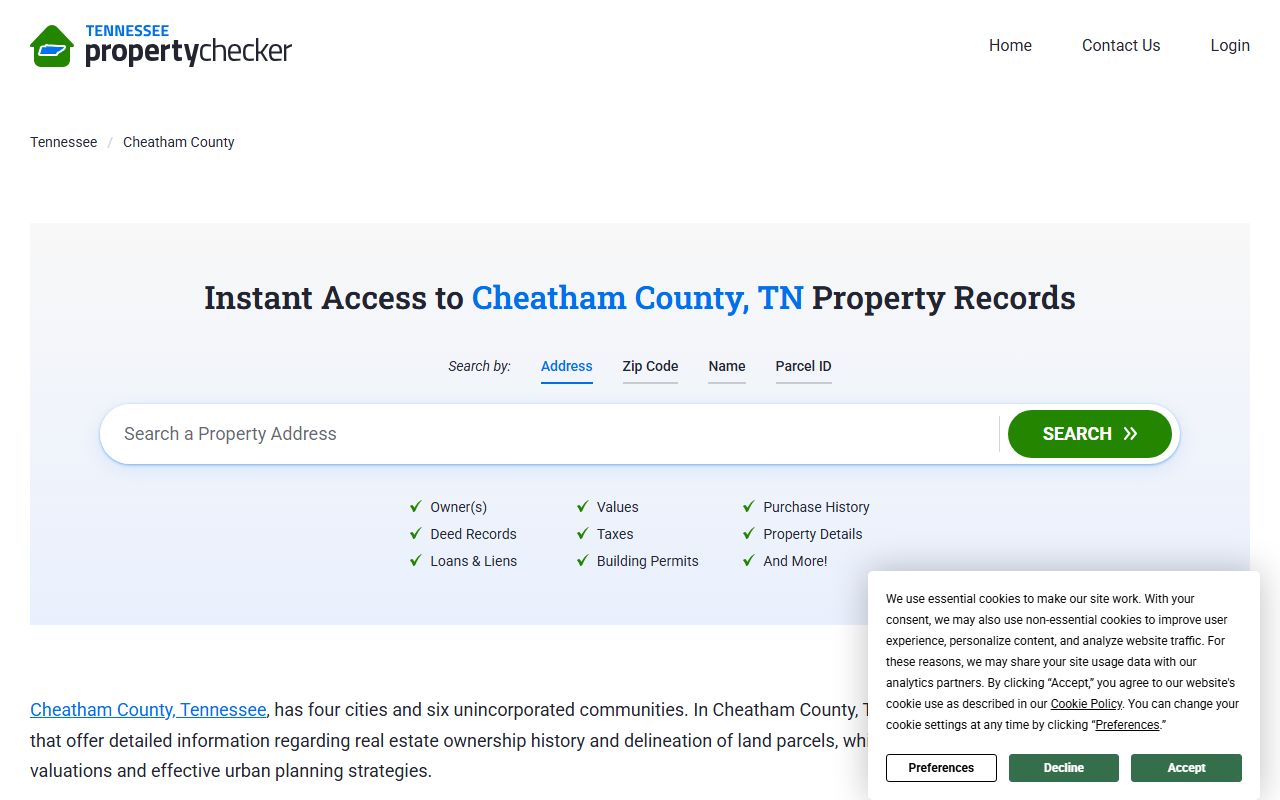
That snapshot is useful for recent chain-of-title work, but the assessor and register still control the official parcel and deed files.
Note: TPAD is the fastest first stop when you already have an address, owner name, or parcel ID.
Cheatham County Deed Records
Cheatham County Property Records do not stop at the parcel card. The official Cheatham County Register of Deeds page identifies Chrissy Henderson as register and places the office at 354 Frey Street, Suite C, Ashland City, TN 37015. The office is open Monday through Friday from 8:00 a.m. to 4:00 p.m. If you need the recorded instrument, the register is the office that keeps the book and page trail for deeds, plats, and other real property documents.
The office FAQ at the Cheatham County register FAQ explains the rules behind copies, indexing, and recording.
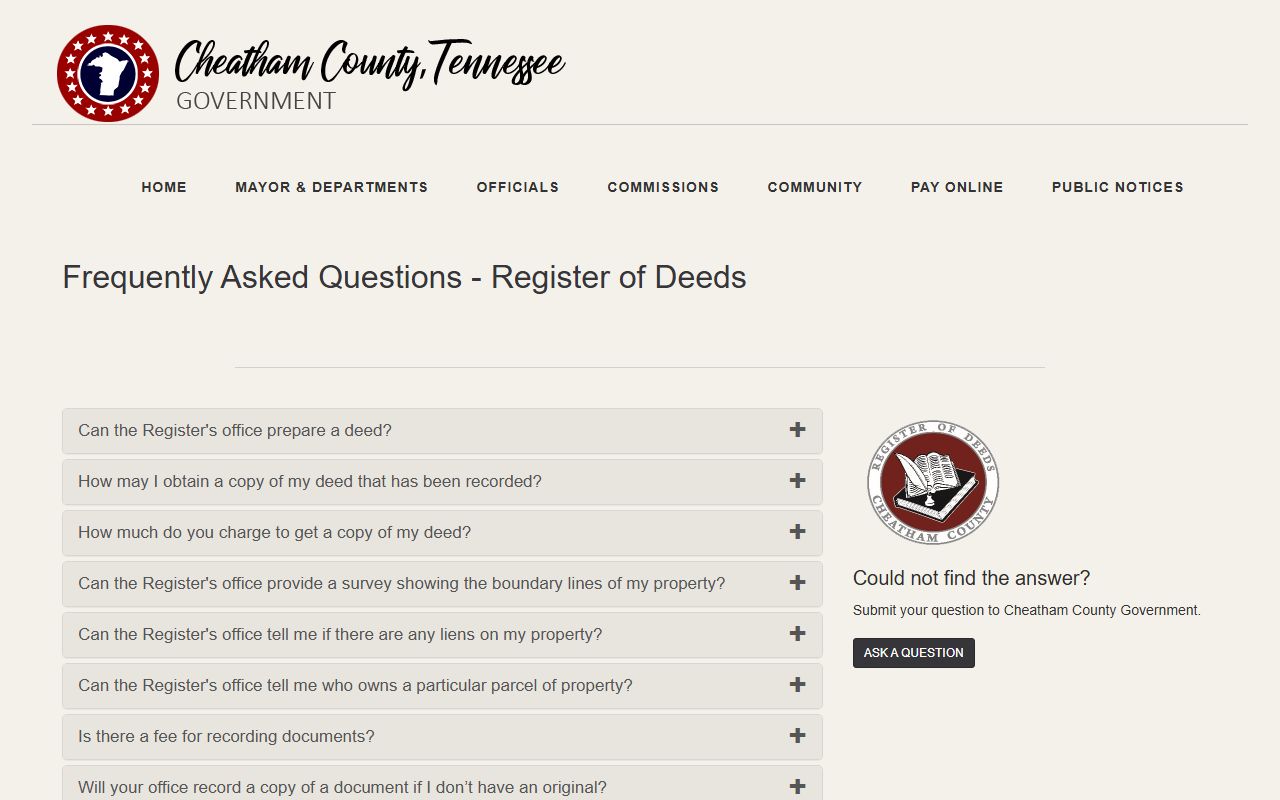
That detail matters because the register works from name-based grantor and grantee indexes, not from an address search.
The county’s recording rules are strict and practical. The office says it cannot prepare deeds, cannot perform title searches to find liens, and needs original documents for recording. It also points people to the assessor for address-based searches when a parcel has no clean name trail. For copies, standard pages are 15 cents each, plat pages are $5 each, and certifications are $1. Those fees are modest, but they still add up when you need a long chain of instruments.
- Original documents are required for recording.
- The office does not prepare deeds.
- The office does not perform title searches.
- Grantor and grantee indexes are name based.
- Address searches should start with the assessor.
- Standard copies are 15 cents per page, plat pages are $5, and certifications are $1.
When the document is already in the county system, the register can usually point you to the right copy type or subscription search path. That is useful if you need a plat for a subdivision lot, a certified copy for closing, or a recorded transfer that matches the deed chain in the assessor file.
Cheatham County Property Records Access
Most Cheatham County Property Records questions can be answered locally, but state-held assessment materials still route through the Comptroller. The public records requests page explains how to ask for Division of Property Assessments records, manuals, policies, and related files. That is the right move when you need state material that is not already in the county card or the recorded deed set.
The state portal and the county offices complement each other. TPAD gets you the parcel card, while the assessor and register answer questions that depend on local facts, office history, or a copied instrument. If a parcel has changed hands several times, keep the current owner, parcel number, and recording date in front of you. Cheatham County Property Records are much easier to follow when you work from the newest event back to the older books.
Because the county register uses grantor and grantee names, a broad request without a parcel clue can take longer than it should. The fastest path is usually an address, a tax map reference, or a deed date range. That approach keeps the search tight and makes it easier for the office to pull the right page set the first time.
Note: A parcel number or recorded owner name keeps the request process much cleaner than a broad search for all records.
Cheatham County Property Records Appeals
Cheatham County Property Records also matter when a value looks wrong. Tennessee requires assessors to send change notices at least 10 calendar days before the local board begins its annual session, so the mailer and the record card should be read together. In Cheatham County, the assessor page lists Board of Equalization sessions on June 2-6 and June 9-13, with weekday hours from 8:30 a.m. to 3:30 p.m. Those dates are the first checkpoint if you want to question a value or a class assignment.
If the local process does not fix the issue, the State Board of Equalization says a property owner can file by August 1 of the tax year, or within 45 days after the local board notice is sent, whichever is later. That deadline is strict, so it helps to keep the notice, the parcel card, and the tax bill together before you begin the appeal. The state board route is not the place to guess at a value. It is the place to show what the county record already says and why the result should change.
- Compare the notice with the assessor’s record card.
- Check the property class and improvement data.
- Gather sale examples, photos, or notes that support your case.
- File local appeal papers before the board session ends.
That evidence-based approach works better than a simple complaint. The county board and the state board both want the same thing: a clear parcel file, a clean timeline, and proof that the record no longer matches the property on the ground.
Note: Keep the notice, the record card, and your appeal proof together so the local board can follow the difference quickly.
Cheatham County Property Records and Relief
Recorded transfers in Tennessee carry a state transfer tax of $0.37 per $100 of consideration or value. That means a deed does more than move ownership. It also has to clear the recording rules tied to tax and consideration language. If the deed or trust instrument is missing the right language, it can slow down the whole recording step. Cheatham County Property Records searches that end in a sale or refinance should always check that part before the document goes in the book.
The state also offers homeowner support through property tax relief and property tax programs. Relief is aimed at qualifying elderly and disabled homeowners, as well as disabled veterans and certain surviving spouses. The freeze program is different. It can cap the tax amount on a qualifying primary residence, but it does not change the underlying value of the property record. Those distinctions matter when someone thinks the assessment itself has changed but the real issue is the bill.
In practice, the best way to use these programs is to verify the parcel first, confirm the owner name, and then talk with the local office about the form that matches your situation. That keeps a tax relief question from turning into a deed or assessment problem by mistake.
Cheatham County Property Records History
The third-party Cheatham County Property Records portal lists deed coverage from 1989 and mortgage coverage from 1993. That is a useful starting point for recent chain-of-title work because it tells you roughly how far a modern online search may reach before you need older paper books or a certified copy. It also shows why a current parcel card and a recent deed should be read together. One source explains the present, and the other explains how the parcel got there.
Older records are usually easier to follow when you work backward. Start with the current owner, then move to the newest transfer, and then keep stepping back through each grantor and grantee pair. Cheatham County Property Records searches become less confusing when you treat every deed as a bridge to the previous one instead of trying to jump straight to the oldest event. That same method works well when a parcel has been split, combined, or passed through a family trust.
If you need a certified copy, a plat, or a name search that reaches beyond the last sale, the register office is still the main local stop. Its subscription search options and copy rules are built for that kind of request, while the assessor file helps you match the right parcel to the right record. The more exact your starting point, the faster the history comes into view.
Related County Pages
These county pages follow the same research pattern, so they make a useful comparison set if you want to see how another Tennessee county handles Property Records, assessment search, and deed access.
Use the county page that matches the parcel before you rely on a deed note or tax detail.