
Search Blount County Property Records
Blount County Property Records bring together deed history, parcel data, assessment values, tax details, and the local rules that shape a clean title search. Most searches begin in Maryville because the county offices, record books, and property tools all converge there. From there, you can move between ownership data, recorded instruments, GIS maps, and tax support without guessing which office controls the next step. This page gathers the most useful Blount County Property Records sources so you can search by name, address, or parcel and keep the research tied to the right local record.
Blount County Property Records Facts
Blount County Property Records Search
The fastest way into Blount County Property Records is the assessment search path. The Tennessee Property Assessment Data portal supports address, owner name, and parcel ID searches, and it shows property record cards with ownership records, land details, improvements, measurements, and classification. That makes it the cleanest first stop when you want to confirm a parcel before asking for a deed copy or tax lookup.
Tennessee's Comptroller says the state supports property assessment work in 86 counties through IMPACT CAMA, so TPAD is the normal statewide tool for Blount County searches. If a record is easy to find online, the portal may be enough for a quick review. If the parcel history is more complicated, the portal gives you the basic facts you need before you move to the register office or the county tax side.
The state assessment page also explains the larger records framework that Blount County users rely on. It ties parcel data to the county assessor's office, and it shows why property records searches work best when you start with the current assessment view and then check the filed documents that support it.
Use the property assessments page when you want the state framework behind the Blount County Property Records search, and go to the TPAD search portal when you need the parcel card itself.
Blount County Register of Deeds
Blount County Property Records also depend on the Register of Deeds, because that office records the instruments that move title and shape the ownership chain. Phyllis Lee Crisp serves as register, and the office is at 349 Court Street, Maryville, TN 37804. Hours are Monday through Friday from 8:00 a.m. to 4:30 p.m., and the phone number is (865) 273-5880. The office accepts cash, checks, credit or debit cards, money orders, and e-filings through Simplifile and CSC.
The county register page at blounttn.org/321/Register-of-Deeds confirms the local filing rules in Maryville. That source matters because Blount County Property Records are not just scanned images. They are recorded documents that must meet format rules before they can be accepted and indexed.
Those rules are specific. All documents must include a Prepared By name and address. Deeds must include the district, map and parcel, and responsible taxpayer name and address. Trust deeds need the maximum principal indebtedness statement. The office also asks for a self-addressed stamped envelope if you want the return mailed back, which helps when you are filing by mail instead of in person.
Recording costs are just as specific. The register lists a $12 fee for the first two pages and $5 for each additional page. Certification is $1 per page for documents and $5 for maps. That is enough detail to plan the filing before you walk into the courthouse.
See the office page for the local filing rules, then use the image below to place the Maryville office in the county record trail.
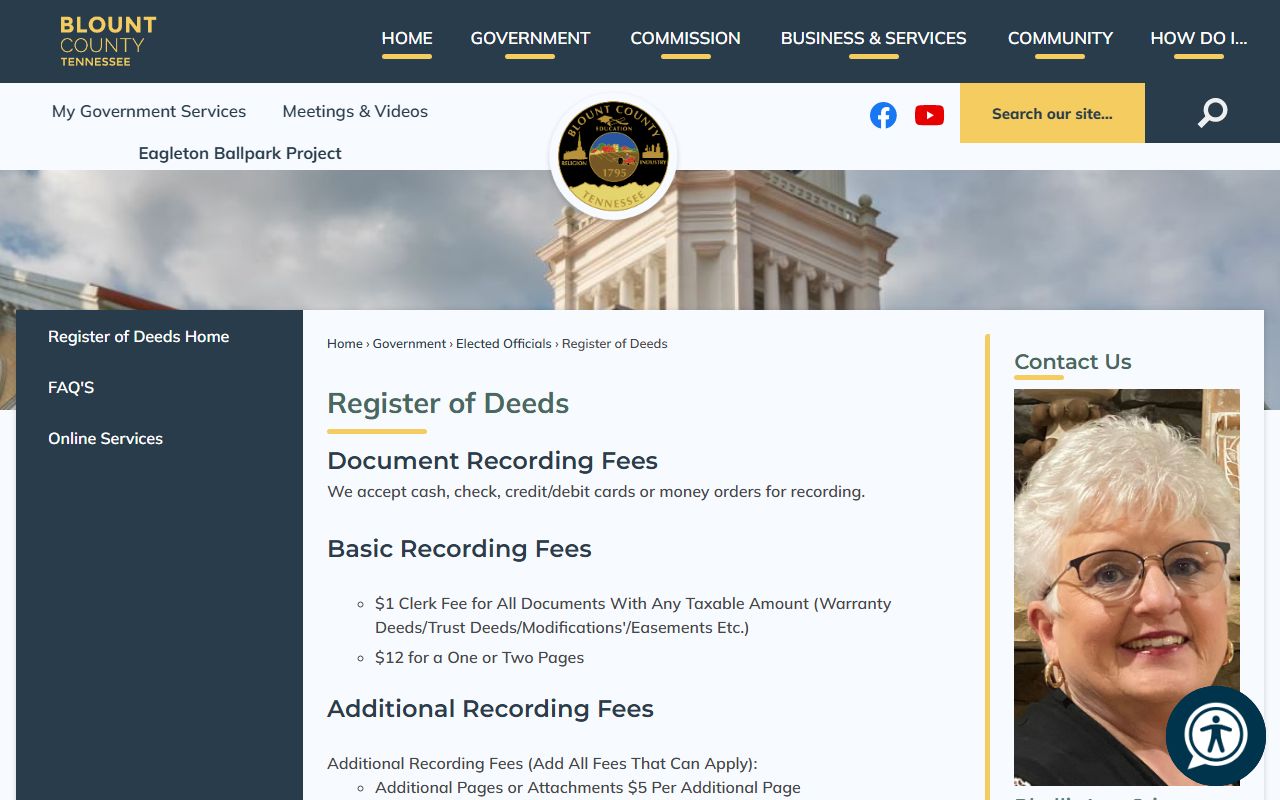
That office is the source for the filed version of Blount County Property Records, so it is the place to verify a deed, a trust deed, or a transfer that is not fully clear in the assessment file.
Blount County Property Records Portal
The county portal at blountrecords.us/property-records adds another path for Blount County Property Records research. It describes recorded property files as the legal ownership trail and points users to a free online assessment database with ownership information, property characteristics, assessment values, and GIS data. That is useful when you want a broad view before you ask for a copy or visit the office.
The same portal notes that public access terminals are available at the Register of Deeds and Property Assessor offices at no cost. That matters for people who want to compare a record card with a deed without paying for a copy first. It also means a walk-in search can still be practical even when you expect to finish most of the work online.
The portal page also lists copy pricing of 50 cents per page for hard copies and $1 per page for certified copies. Those fees are different from recording fees, so it helps to separate the cost of seeing a record from the cost of filing a new one. For Blount County Property Records, that distinction saves time and keeps your budget clear.
Read the portal page before you order copies, because it gives you the local access path, the fee structure, and the office locations in one place.
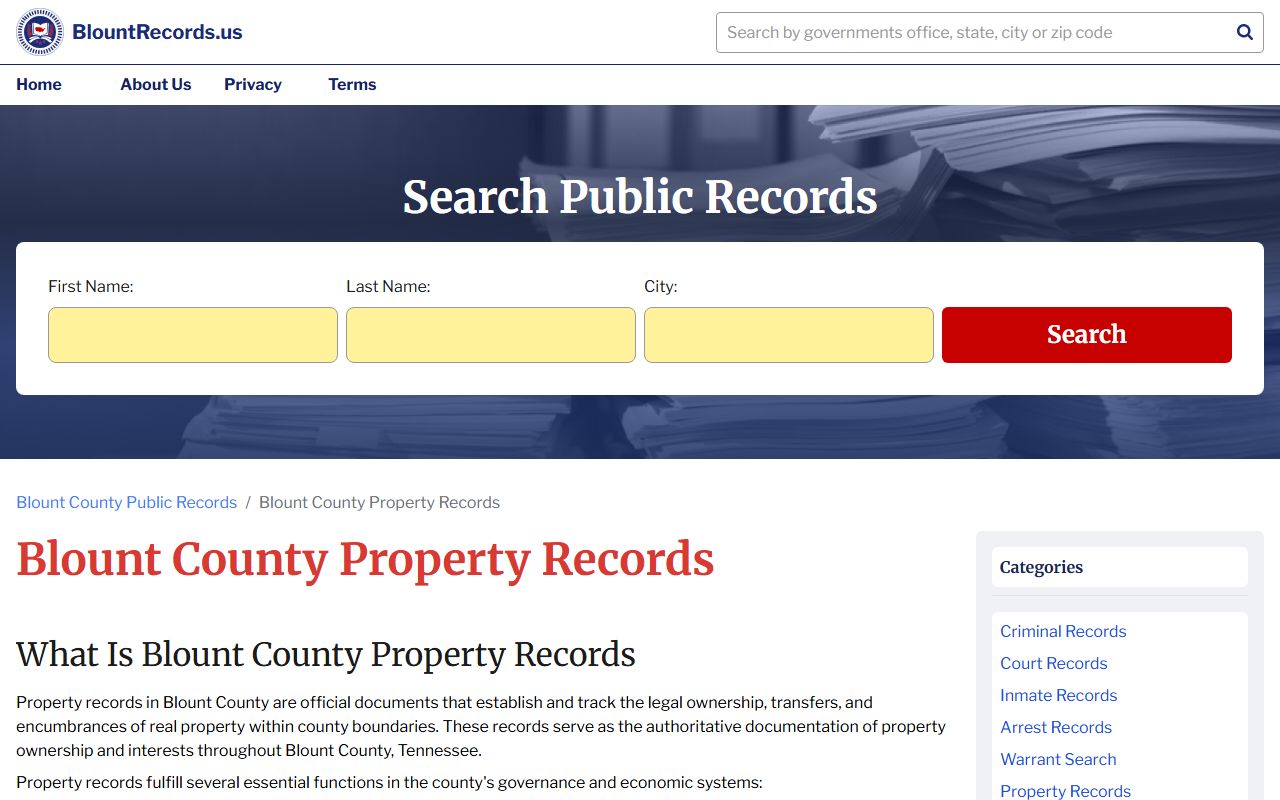
This portal view is useful when you need a quick property records check before a more formal request, especially if you are tracing ownership across a sale, refinance, or inheritance.
Blount County Property Records GIS
Blount County Property Records are easier to read when you pair them with GIS. The county website at blounttn.org supports GIS tools, online services, parcel boundaries, aerial imagery, zoning maps for unincorporated areas, FEMA flood data, and printable maps. The county also says it manages roughly 50,000-plus parcels, which helps explain why map-based search tools matter so much in a growing county.
The assessor office is part of that picture too. The Property Assessor is located at 351 Court Street, Maryville, TN 37804, with phone number (865) 273-5850 and fax (865) 273-5866. The free online assessment database and the county map layers work together, so a parcel number, street address, or owner name can lead you from one record system to the next without losing the thread.
Tennessee assessment rules still matter here. County assessors must send change notices at least 10 calendar days before the local board of equalization begins its annual session. That notice window gives property owners time to compare the new value against the parcel card, the map, and any deed history that may explain the change.
Blount County Property Records searches are strongest when the map and the record card agree. If the boundaries, ownership, or building data do not line up, the GIS layer often shows the first clue.
Blount County Property Records Fees
Recording fees in Blount County are only part of the cost of a filing. The register charges $12 for the first two pages and $5 for each additional page, while certification costs $1 per page for documents and $5 for maps. Those numbers are small, but they add up when a deed, trust deed, or plat runs long. The county office also requires the right document setup before it will accept the filing.
The state transfer tax adds another layer. Tennessee charges $0.37 per $100 of value or consideration, and the Department of Revenue explains the rule on its real property transfer tax page. Deeds must also include an affidavit of consideration to be recordable. If you are filing a transfer in Blount County Property Records, the page count and the transfer value both matter.
Local recording rules are part of the same cost picture. Blount County requires a Prepared By name and address, along with the district, map and parcel, and responsible taxpayer name and address on deeds. Trust deeds need the maximum principal indebtedness statement. If any of those items are missing, the document can come back unrecorded and cost more time than the page fee itself.
Use the CTAS registers of deeds directory when you want a statewide fee and contact reference, and check the real property transfer tax page before you file anything that transfers value.
Note: A clean deed package is cheaper than a correction visit, so it is worth checking the page count, the tax amount, and the required wording before you record.
Blount County Appeals and Relief
Assessment disputes in Blount County follow Tennessee's broader appeal path. If a parcel value looks wrong, the county board of equalization is the first stop, and the State Board of Equalization handles the next level. State appeals must be filed on or before August 1 of the tax year, or within 45 days after the local board action notice was sent, whichever is later.
The State Board of Equalization page gives the appeal framework, and the state property assessment page explains that taxpayers should receive change notices at least 10 calendar days before the local board begins its annual session. That timing helps owners compare the notice with the parcel card and the GIS record before a deadline passes.
If the issue is not a value dispute, the state tax programs page may be the better answer. Tennessee offers tax relief for eligible elderly and disabled homeowners, and the tax freeze program can lock the tax amount for qualifying homeowners age 65 and older. Both programs are tied to a primary residence, so they only fit some parcels.
Use the property tax programs page when you want the relief and freeze rules, and use the public records requests page when you need state-held assessment material that is not already online.
Note: Keep the notice date, board date, and filing deadline together, because appeal windows can close fast even when the parcel issue seems simple.
Related County Pages
Blount County Property Records often make more sense when you compare them with other Tennessee county pages on the site. The structure, search order, and office mix stay similar from county to county, but the local details still matter. If you are comparing how counties handle deeds, assessment cards, or tax help, the other county pages below can give you a fast reference point.
Use these county pages if you are comparing record formats or checking how another county frames its own property records search.
Cross-checking another county page can help you spot which Blount County Property Records details are local and which ones follow the statewide Tennessee pattern.